Search by topic
- archaeology
- Building of Local Interest
- chapel
- charity
- church
- crime
- dressmaker
- fire
- Great Eastern Railway
- Listed building
- Mapping Relief
- medieval
- oral history
- poverty
- Public House
- Religious House
- Roman
- scholar
- school
- Then and Now
- tudor
- women
- work
- world war one
- world war two
Search by text
Mary Greene – The Joy of Remembering – An Artist’s Life in Cambridge
Mary Greene, artist, teacher and writer, records her life in Cambridge and its surrounding villages in her autobiography The Joy of Remembering.
Mary Greene’s life and work in Cambridge
Mary Greene’s career was closely bound to Cambridge, where she worked as a painter, teacher and later a writer of plays. Although she spent periods in nearby villages such as Grantchester and Harston, Cambridge remained the centre of her professional and creative life.
She describes the difficulty of sustaining an artistic practice in the city, including a period when she was forced to teach in “two poor little rooms” that were wholly unsuitable for her work.
Her fortunes changed when she acquired and adapted a property to create her own studio, which became the base for her painting, teaching and wider artistic activities.
Garden Alley and Mary Greene’s studio
One of the most distinctive episodes in Mary Greene’s Cambridge life is her creation of “Garden Alley”, the unnamed lane on which her studio stood.
By naming the lane herself and informing the Post Office, she effectively created a new Cambridge address—only to be summoned before the Town Hall for doing so without authority. The episode illustrates both her independence and the informal development of parts of Cambridge at the time.
Despite official objections, “Garden Alley” remained in use locally, and became closely associated with Mary Greene’s studio and artistic work.
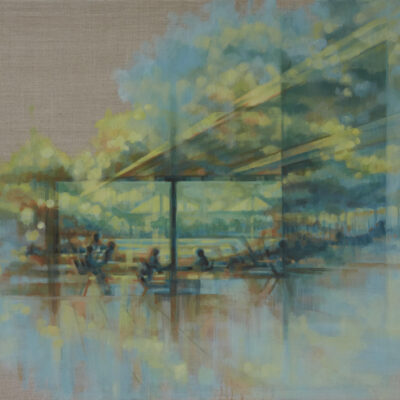
Painting, teaching and artistic practice
Mary Greene’s primary identity was as a painter. Her work included:
- narrative and historical subjects
- series of drawings inspired by biblical and literary themes
- compositions conceived visually, almost as staged scenes
Even during illness, she continued to plan and develop artistic ideas.
Her Cambridge studio supported a broad practice:
- teaching art students
- running a weaving school in Botolph Lane
- designing and producing work with assistants
Her work reflects a blend of fine art, craft and education, characteristic of the wider artistic culture of the period.
Mary Greene’s expansion into drama and writing
Later in life, Mary Greene expanded her creative work into drama and writing. From her Cambridge base she:
- wrote plays based on historical and artistic subjects
- staged village productions and pageants
- painted scenery and contributed songs
After the First World War, these performances became an important part of her creative output.
Her play “An Afternoon with Blake” was broadcast by the BBC in 1940, marking a significant public recognition of her work.
Friends, acquaintances and Cambridge society
Mary Greene’s autobiography is rich in encounters with Cambridge figures from a wide range of backgrounds. These include:
- Dr Lumby of Grantchester, part of her intellectual circle
- Mr. Magnussen, an Icelandic scholar associated with Cambridge
- Lady George Darwin, encountered overlooking Coe Fen
- Mr. Kett, a major Cambridge builder involved in shaping the city
- Graham Greene, the novelist, who read and commented on her plays
These relationships illustrate the interconnected nature of Cambridge society, where academic, artistic and domestic worlds overlapped.
Mary Greene and the Cambridge landscape
Mary Greene shows a strong attachment to Cambridge’s environment, particularly Coe Fen, which she regarded as a unique and irreplaceable part of the শহ’s character.
She took an active interest in its preservation and engaged in discussions about its future, reflecting early concerns about conservation and urban change.
Historical value of Mary Greene’s autobiography
Mary Greene’s The Joy of Remembering provides:
- a rare account of a woman artist working in Cambridge
- insight into studio life, teaching and creative practice
- detailed evidence of social networks and everyday encounters
- valuable references to streets, buildings and landscapes
It complements official records by capturing Cambridge as it was lived and experienced.
Key Cambridge locations associated with Mary Greene
- Garden Alley (studio)
- Botolph Lane (weaving school)
- Bateman Street
- Coe Fen
- Christ’s Pieces
- Grantchester
- Harston
Texts
Pages 1-18. Preface and chapter 1, ‘Early Days in Grantchester,’ describing her family and schooling in the Old Vicarage.
Old Vicarage Grantchester, the Widnalls and Lally Smith
Pages 19-27. ‘My School and Home in Bedford’
Pages 28-35. ‘I visit my Uncle’. Uncle Benjamin was a Director of the Bank of England for 50 years and became its Governor.
Benjamin Green and Bank of England
Pages 36-48. ‘Studio Training’ as an artist in London
Manet’s Execution of Emperor Maximilian of Mexico
Pages 49-64. ‘I start Work and make Friends’, her return to Harston and Cambridge
Daisy Stewart and Mr Jenkinson, University librarian
Silvia Myers
Pages 65-70. ‘The Naming of the Lane’, living in Cambridge and meeting with Alderman Kett
Pages 71-89. ‘Harston and its people’
Pages 90 -99. ‘Some sketching stories’
Pages 100-106. ‘The Children of the Studio’, her pupils
Hopkinsons
Pages 107-122. ‘The Garden Alley Studio’
Pages 123-141. ‘About my pictures’
Pages 142-153. ‘About my writing’
Pages 154-160. ‘People I have met’ – ‘The Magnussens’
Page 161-169. ‘Mr Oswald Fisher, Rector of Harlton’
Page 170-180. ‘The Lady of the London Docks’
Pages 181-186. ‘The lady of Valparaiso’
Lady Frazer and The Golden Bough
Pages 187-195. ‘The lady of the Roman Catholic Church in Cambridge’
Pages 196-205. ‘The finders of the Syriac Codex’
Pages 206-213. ‘Miss Hargood’s Party’
Pages 214-225. ‘The Schallings of Saltsjøbaden’
Pages 226-245. ‘My Visits Abroad’ – ‘Three Times to Italy’
Pages 246-261. ‘Two visits to Holland’
Pages 262-274. ‘A Holiday in France’
Pages 275-284. ‘Midsummer in Sweden’
Pages 285-296. ‘Holidays among the Alps’
Pages 297-315. ‘In Brazil’
Page 316-229. ‘Buenos Ayres and home to England’
Pages 330-338. ‘Harston House and Garden’
Sources
- Oral / Unpublished Sources
Contribute
Do you have any information about the people or places in this article? If so, then please let us know using the Contact page or by emailing capturingcambridge@
Licence
This work is licensed under CC BY-NC-SA 4.0