Search by topic
- archaeology
- Building of Local Interest
- chapel
- charity
- church
- crime
- dressmaker
- Great Eastern Railway
- Listed building
- Mapping Relief
- medieval
- oral history
- poverty
- Public House
- railway worker
- Religious House
- Roman
- scholar
- school
- Then and Now
- tudor
- women
- work
- world war one
- world war two
Search by text





Hemingford Road, Romsey Town, Cambridge – A Street History and People (1878-2012)
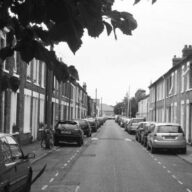
Hemingford Road in Romsey Town was created after the 1878 sale of the Romsey Cottage estate, transforming Barnwell fields into a dense working-class suburb tied to the railway.
The history of Hemingford is told in great detail in the local published book “Hemingford Road 1878-2012”. It was written by Allan Brigham for the Hemingford and Romsey Road’s Street party in 2012.
The book is in 3 parts.
- Hemingford Road & Romsey Recreation Ground – A History. Introduction & Stories. 1878-2012
- Hemingford Road – House Histories.1. Odd numbers. 1-129
- Hemingford Road – House Histories.2. Even numbers. Romsey Mill-112
The raw ownership data is also available.
From fields to suburb
Before Hemingford Road existed, this area lay within Barnwell Fields, a landscape of open ground and market gardens on the edge of Cambridge. In the early nineteenth century Mill Road was still semi-rural, but the arrival of the railway in 1845 triggered rapid expansion. By the time the Romsey Cottage estate was put up for sale in 1878, the pressure for housing was intense, and new streets were laid out across former farmland.
Hemingford Road emerged from this process not as a single planned development but as a street built incrementally, plot by plot, over several decades.
Building the street
The earliest houses appeared in the 1880s, with further construction continuing into the early twentieth century. The development was shaped by small-scale builders and investors rather than a single estate developer, giving the street a varied but coherent character.
Some groups of houses were given names that still survive. Fern Cottages, built in 1889 for W. J. Webb, represent an early cluster of modest homes. Pretoria Terrace, constructed in stages between the 1880s and about 1910, reflects both the slow pace of development and the imperial culture of the time, its name recalling the Boer War.
Other properties were built individually, sometimes combining home and workplace. Hemingford House, for example, included a smithy, illustrating how closely domestic and working life were intertwined.
Who lived here
From the outset, Hemingford Road was a street of working people. Census records and early directories show a population dominated by railway employees and building trades, alongside laundresses, labourers and other service occupations. Many residents were not Cambridge-born but had moved from elsewhere in East Anglia or further afield, drawn by employment opportunities.
The detailed house histories reveal the texture of everyday life: large families, frequent lodgers, and movement between nearby streets rather than long-distance relocation. At the same time, the household database extending from 1880 to 1970 shows that many residents stayed for long periods, sometimes for decades, and in some cases across generations.
This combination of mobility and stability helped to create a strong sense of local identity.
Tenure and change
In the late nineteenth century most houses were rented, often on weekly tenancies. By the mid-twentieth century this pattern had begun to shift, with increasing numbers of residents becoming owner-occupiers. The records show how this transition unfolded gradually, alongside modest social mobility, as families moved from labouring work into more skilled or secure employment.
Occupational patterns also diversified over time. While railway and building trades dominated the early decades, later residents included a wider range of professions, reflecting broader changes in Cambridge’s economy.
Community and identity
Hemingford Road formed part of what became known as “Red Romsey”, an area associated with strong trade union activity and a distinct working-class culture. The street was never simply a collection of houses; it functioned as a social network, with families connected across neighbouring properties and shared institutions.
Two places in particular shaped this identity. The Wesleyan chapel, built in the 1890s and later expanded, became a focal point for religious and social life before evolving into today’s Romsey Mill community centre. At the end of the road, Romsey Recreation Ground—secured after sustained local campaigning and opened in the years around the First World War—provided a vital shared green space, often described by residents as an “oasis” within the dense urban environment.
The character of the street
The physical fabric of Hemingford Road reflects its phased development. Early houses were often built in pale Cambridge brick, while later additions introduced red brick and more decorative detailing. Although built over several decades, the street retains a consistent scale and rhythm, typical of late Victorian and Edwardian suburban expansion.
What distinguishes Hemingford Road is not simply its architecture but the depth of its documentation. Few Cambridge streets can be traced in such detail from first construction through to mid-twentieth-century occupation, allowing the lives of ordinary residents to be reconstructed with unusual clarity.
Hemingford Road over time
From its beginnings as a new working-class suburb on the edge of town, Hemingford Road developed into a settled and cohesive community. By the mid-twentieth century it had become a stable neighbourhood with long-standing residents and increasing levels of home ownership. In more recent decades it has continued to change, but still retains something of its original character as a place shaped by work, migration and community ties.
Projects
Contribute
Do you have any information about the people or places in this article? If so, then please let us know using the Contact page or by emailing capturingcambridge@
Licence
This work is licensed under CC BY-NC-SA 4.0